NOTE
NOTE sets each trig’s length and note. Notes come from one of three value sources: a random value in a range (RANGE), a short list played in an order (LIST), or a slow contour (NOISE). LOCK’s lanes use the same three sources.
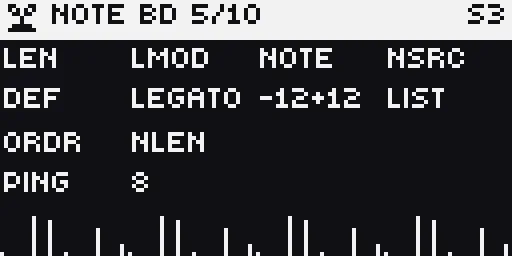
| Knob | Name | Values | Default | Shown |
|---|---|---|---|---|
| A | LEN | DEF, or a range of lengths 1/128 … INF | DEF | always |
| B | LMOD | RANGE, LEGATO | RANGE | always |
| C | NOTE | DEF, or a range −24…+24 semitones | DEF | always |
| D | NSRC | RANGE, LIST, NOISE | RANGE | always |
| E | ORDR | UP, DOWN, PING, PNG2, ODD, RAND | UP | while NSRC is LIST |
| F | NLEN | 1–16 | 4 | while NSRC is LIST |
| G | ZOOM | 1–64 | 4 | while NSRC is NOISE |
LEN and LMOD
Section titled “LEN and LMOD”LEN is a range of the Rytm’s note lengths, shown as note values (1/16, 1/8, 1/4 …) where they are one and in steps otherwise (1.25), up to INF. Each trig gets a random length in the range. At DEF lengths are left as they are; the first turn up starts at 1/16. LEN is a range knob: the knob sets the high end, FUNC + knob the low end.
LMOD = LEGATO makes each trig last until the next trig: it gets the shortest of the Rytm’s lengths that reaches it (1 step is 1/16, 2 steps 1/8, 4 steps 1/4). The last trig reaches the first one, a loop later; a lone trig lasts the whole track. A gap of an odd number of steps above 32 has no exact length and gets the next one up (33 steps: 34). Micro timing is not taken into account. LEGATO measures the gaps where the trigs end up after PLACE, and LEN is not used while it is on.
NOTE and NSRC
Section titled “NOTE and NSRC”NOTE is a range of semitones from the track’s default note, −24 to +24. At DEF notes are left as they are, whatever NSRC says; the first turn up starts at +0. NOTE is a range knob.
NSRC picks where the notes in that range come from:
| NSRC | Each trig gets |
|---|---|
| RANGE | a random note in the range |
| LIST | the next value of a short list, in the order ORDR says |
| NOISE | the value of a slow contour at its step |
LIST: values in an order
Section titled “LIST: values in an order”A list gives the trigs a short sequence of values in a fixed order, the way an arpeggiator walks its notes.
The list. NLEN values are drawn from the range, then sorted from low to high. The seed decides the values; with VARY above 0 the next take keeps some of them and draws the others again. A list of length 1 gives every trig the same value; a range narrower than the list gives repeated values.
The order. The trigs take the list’s values one after another, from the track’s first trig to its last; at the end of the list it starts again. With the sorted list numbered 1 to N:
| ORDR | Trigs get (N = 4) | Repeats every |
|---|---|---|
| UP | 1 2 3 4 1 2 3 4 … | N trigs |
| DOWN | 4 3 2 1 4 3 2 1 … | N trigs |
| PING | 1 2 3 4 3 2 1 2 … (the ends once) | 2N − 2 trigs |
| PNG2 | 1 2 3 4 4 3 2 1 1 … (the ends twice) | 2N trigs |
| ODD | 1 3 2 4 1 3 … (odd places, then even; N = 5: 1 3 5 2 4) | N trigs |
| RAND | a value from the list at random on each trig |
These orders are as built in 0.7; beta feedback may change them before 1.0.
NOISE: a contour over the steps
Section titled “NOISE: a contour over the steps”NOISE gives a value that changes slowly from step to step instead of jumping at random. Every ZOOM steps there is a random level, and the steps between move from one level to the next along an S-curve. The result is a contour: a note line that drifts up and down, a filter or sample lock that sweeps, a velocity that swells and falls (DYNAMICS’ SHAPE = NOISE, with N as its ZOOM).
| ZOOM | Result |
|---|---|
| 1 | a new random level on every step: the same spread as RANGE |
| 2–8 | a contour that turns every few steps |
| 16–64 | a slow sweep over a page or the whole track |
- The contour’s lowest level is the range’s low end and its highest the high end.
- The track’s first step is always one of the random levels, and the contour wraps at the track’s length: the last steps lead back to the first step’s level, so the loop has no jump. When the length is not a multiple of ZOOM, the last stretch is shorter.
- The step, not the trig. A trig’s value comes from the contour at its step. Raising DENS or a lane’s % adds trigs or locks without changing the values of those already there, and removing a trig changes no other trig’s value.
- SEED and VARY. Each random level is one of the take’s random numbers: with VARY at k %, the next seed keeps about k % of the levels. NOTE, each LOCK lane and DYNAMICS’ shape draw different contours from the same take, so turning one does not change another.