RHYTHM
RHYTHM decides which steps have trigs. It is the only page that makes trigs; every later page shapes or dresses the trigs it gives. SRC (knob A) picks the source, and the other knobs are the source’s own.
| SRC | Title bar | Knobs | Trigs |
|---|---|---|---|
| TRACK | TRK |
none | the trigs that are on the track, with everything they carry |
| RAND | S + seed |
GRID, DENS, BIAS, ROLE | an exact share of the grid’s steps, chosen by chance and the meter |
| EUCLID | EUC |
STEPS, PULS | pulses spread evenly over a cycle, as stock’s Euclidean mode |
| MAP | MAP, or S + seed from CHAOS 4 |
PART, DENS, X, Y, CHAOS | a rhythm read from a map of drum patterns |
| COPY | CPY |
TRK | the trig positions of another track |
| Knob | Name | Values | Default | Shown |
|---|---|---|---|---|
| A | SRC | TRACK, RAND, EUCLID, MAP, COPY | TRACK on a track with trigs, RAND on an empty one | always |
A new recipe starts on TRACK when the track has trigs and on RAND when it is empty. Each source’s settings are kept while another source is chosen.
A trig a source makes (every source but TRACK) starts with the track’s defaults: note, velocity, length, no condition, no locks, and SYN, SMP and ENV on, as a trig from the TRIG keys. The later pages fill its fields.
The trigs on the track as they are, parameter locks and all. The later pages change only what they are set to change: with every page at 0, YES leaves the track byte for byte as it was. Use it to dress a beat you programmed: accents, conditions, a groove, sample locks.
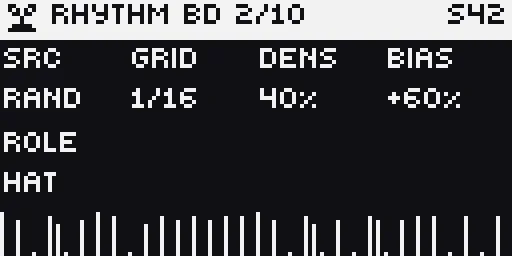
| Knob | Name | Values | Default | Shown | Does |
|---|---|---|---|---|---|
| B | GRID | 1/16, 1/8, 1/4, 1/2 | 1/16 | with SRC = RAND | trigs land only on multiples of the grid |
| C | DENS | 0–100 % | 50 % | with SRC = RAND | the share of the grid’s steps that get a trig, exactly (rounded) |
| D | BIAS | −100…+100 % | 0 % | with SRC = RAND | towards the strong steps (+) or the weak steps (−) of the meter |
| E | ROLE | METER, KICK, BACK, HAT, PERC | METER | with SRC = RAND, while BIAS is not 0 | which steps count as strong |
DENS is a share knob: raising it keeps the trigs that were there and adds more, lowering it removes them in reverse. BIAS mixes the meter’s rank with chance: at 0 every step is equally likely, at +100 DENS fills the steps in rank order, at −100 in reverse rank order. DENS still gives its exact count.
ROLE picks the rank order BIAS follows. The meter is TAKE’s METR and BEAT (the rank).
| ROLE | 4/4, BEAT 4: the steps it fills first |
|---|---|
| METER | the bar’s ranks: 1, 9, 13, 5 |
| KICK | the bar, the half bar, then the “&“s and sixteenths, beats 2 and 4 last: 1, 9, 15, 7 |
| BACK | beats 2 and 4, then sixteenths as ghost notes, the bar’s first step last: 13, 5, 16, 8 |
| HAT | the “&“s, then the beats, then the sixteenths: 15, 7, 11, 3 |
| PERC | the sixteenths, pickups first: 16, 8, 12, 4 |
Each role works the same way in every meter: in 6/8 BACK starts on the second dotted quarter and HAT on the eighths between them. These orders are as built in 0.7; beta feedback may change them before 1.0.
EUCLID
Section titled “EUCLID”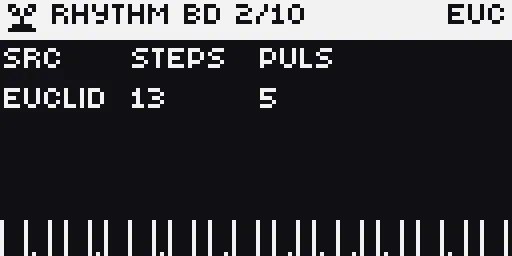
| Knob | Name | Values | Default | Shown | Does |
|---|---|---|---|---|---|
| B | STEPS | 1–64 | 16 | with SRC = EUCLID | the cycle’s length in steps |
| C | PULS | 0–64 | 4 | with SRC = EUCLID | pulses in each cycle; above STEPS, every step has a trig |
The pattern is the one the Rytm’s own Euclidean mode plays (the EUCLIDEAN page) with LEN = STEPS, PL1 = PULS, PL2 at 0 and no rotation. The cycle’s first step always has a pulse, and the gaps between pulses differ by at most one step.
| STEPS | PULS | Pattern |
|---|---|---|
| 16 | 4 | x...x...x...x... |
| 16 | 5 | x...x..x..x..x.. |
| 16 | 7 | x..x.x.x..x.x.x. |
| 8 | 3 | x..x..x. |
| 13 | 5 | x..x..x.x..x. |
A track longer than STEPS repeats the cycle (STEPS 12 on 64 steps plays it five times, then its first four steps); a shorter track plays the cycle’s start. Use PLACE ROT to rotate it.
EUCLID draws no random numbers: SEED and VARY do not change the rhythm, only the random values later pages draw.
Differences from stock’s Euclidean mode:
- Trig Seedr writes ordinary trigs. The track is not in Euclidean mode, and the trigs can be edited by hand.
- Stock’s second generator (PL2, RO2) and its operator are not part of EUCLID.
- STEPS is independent of the track’s length.
- Trig Seedr does not write to a track that is in Euclidean mode (EUCLID IS ON: TURN IT OFF).
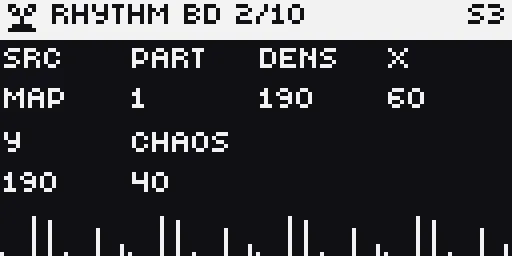
SRC = MAP reads a rhythm from a map of drum patterns. The map and the way it is read come from an open source drum sequencer, credited in the acknowledgements.
| Knob | Name | Values | Default | Shown | Does |
|---|---|---|---|---|---|
| B | PART | 1–3 | 1 | with SRC = MAP | the map’s part: 1 is written for kick drums, 2 for snares, 3 for hats (per track) |
| C | DENS | 0–255 | 128 | with SRC = MAP | how many steps fire: 0 none, 255 every step the part plays at all (per track) |
| D | X | 0–255 | 128 | with SRC = MAP | the place on the map, across (shared by all tracks) |
| E | Y | 0–255 | 128 | with SRC = MAP | the place on the map, down (shared by all tracks) |
| F | CHAOS | 0–255 | 0 | with SRC = MAP | a random lift of the levels, from the seed (shared by all tracks) |
X, Y and CHAOS are shared: turning X on BD’s page turns it for SD too. PART and DENS belong to each track, so BD on part 1, SD on part 2 and a hat on part 3 at the same X and Y make a kit from one place on the map, and DENS thins or fills each one.
The map is a grid of 5 × 5 patterns of 32 steps, each with three parts. Every step of a part has a level from 0 to 255: how strongly that step belongs to the rhythm. X and Y move across the grid; between patterns the four nearest are blended, so turning X or Y changes the rhythm gradually. A step fires when its level is above 255 − DENS: raising DENS only adds steps, the strongest first. A track longer than 32 steps repeats the 32 (64 steps plays them twice); a shorter track plays their start.
CHAOS lifts every level of a part by a random amount, the same over each 32 steps, up to CHAOS / 4 (62 at
CHAOS 255). A lifted step can fire at a DENS where it did not before, so CHAOS adds steps near the threshold. The
lift comes from the seed: YES with no knob turned takes the next seed and a new lift, and on a 64-step track each
half gets its own. With CHAOS below 4 there is no lift and the seed does not change the rhythm; the title bar then
shows MAP, and from CHAOS 4 on S and the seed.
The map’s levels are also used on DYNAMICS: SHAPE = MAP sets velocity from them, and ACC with AMOD = TOP accents the same trigs the original sequencer accents (DYNAMICS).
Differences from the original sequencer:
- Trig Seedr writes ordinary trigs; the map is read once per YES, not as the pattern plays.
- The original’s swing and its Euclidean mode are not part of MAP (TIME’s grooves and SRC = EUCLID cover them).
- Under TAKE’s PHRS, each page plays the map’s first 16 steps (PHRS).
| Knob | Name | Values | Default | Shown | Does |
|---|---|---|---|---|---|
| B | TRK | the pattern’s tracks, BD … FX | BD | with SRC = COPY | the track whose trig positions are taken |
Step i gets a trig when TRK has a trig on step i. Only the positions are taken: TRK’s velocities, notes, locks and conditions are not copied, and the later pages fill the new trigs’ fields.
- Lengths. A TRK shorter than the track repeats, as it does when the pattern plays (a 12-step TRK on a 16-step track gives its 12 steps, then its first 4 again). A longer TRK gives its first steps.
- TRK = the track itself gives the track’s own trig positions with every field back at its default: a way to start again on the same rhythm.
- Trigs as they play. A muted trig counts. A track in stock’s Euclidean mode gives the pattern its Euclidean mode plays, not the trigs stored in it.
- COPY draws no random numbers: SEED and VARY change only the later pages.
- COPY reads the other track as it is now; the strip follows it when you change that track. A take already written does not change when the other track changes later; YES renders it again.